
Custom Garage Storage Sarasota: How to Design a Garage That Actually Stays Organized
The garage gets cleaned. For a couple of weeks, everything has a place. Then packages appear by the door, tools stay on the work surface, sports equipment lands on the floor, and beach gear gets pushed into the nearest open corner.
The problem is not always a lack of effort. Often, the garage simply does not have a storage system built around how the household actually uses it.
Custom garage storage Sarasota homeowners choose should start with that question: what enters the garage, where does it naturally land, where should it belong, and how easy is it to put away?
That makes garage organization a planning problem before it becomes a cabinet or shelving decision. The right system should support vehicles, daily routines, hobbies, household overflow, and seasonal storage without allowing the floor to become the default storage area.
Start With the Question: What Actually Enters Your Garage?
Before comparing garage cabinets Sarasota homeowners may be considering, take an inventory of what needs to be stored.
Depending on the household, that could include:
Tools and hardware
Automotive supplies
Sports equipment
Golf equipment
Beach gear
Lawn and garden items
Cleaning supplies
Bulk household goods
Pet supplies
Luggage
Holiday decorations
Coolers
Recycling
Shoes
Packages and deliveries
The first design decision is not how much storage you can fit along the walls. It is what specifically needs a home.
This matters because unrelated categories often end up competing for the same shelf or work surface. Once you know what needs to be stored, you can decide which items need cabinets, which need open access, and which can go into less accessible areas.
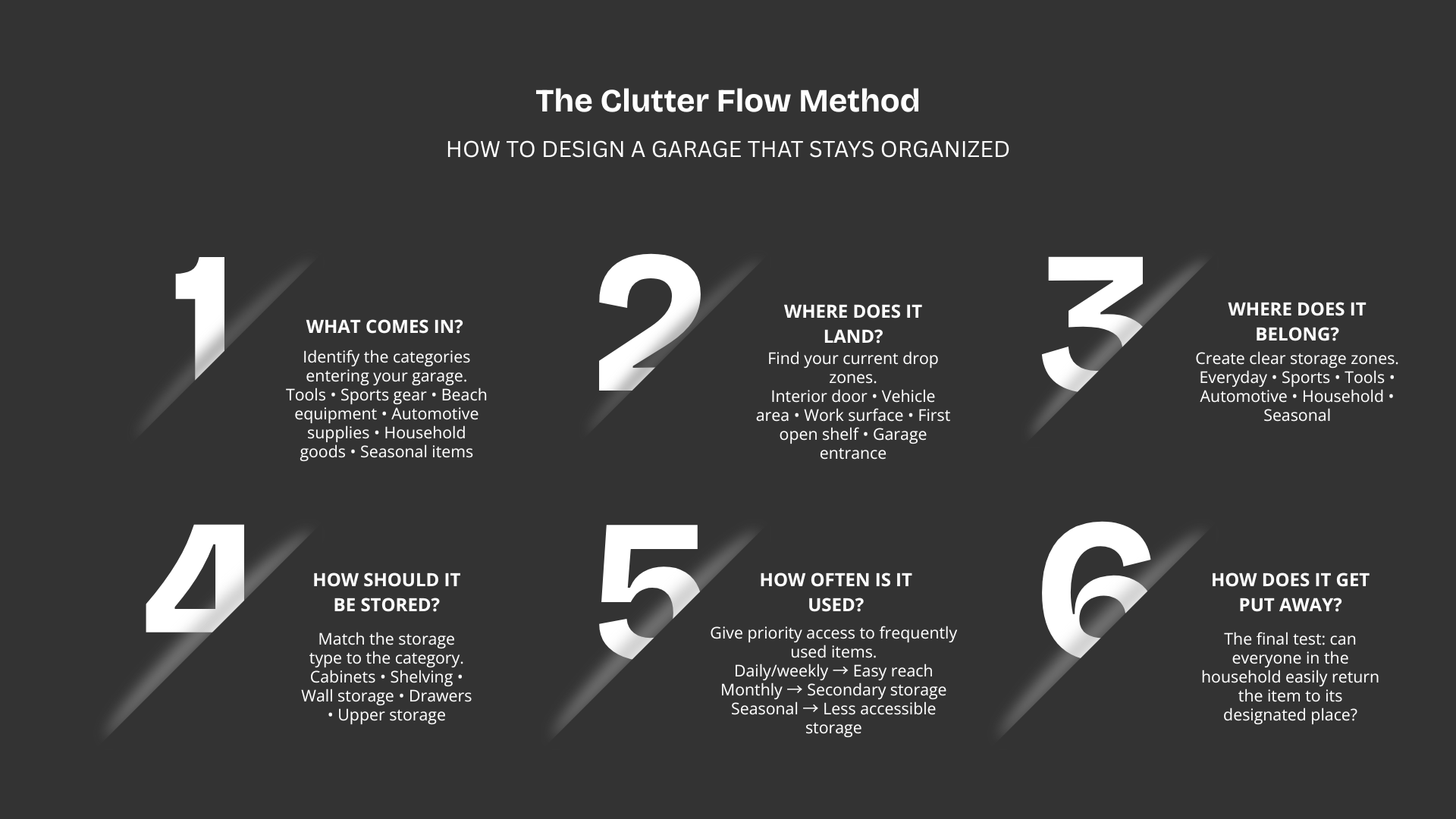
Find Your Garage's "Drop Zones"
Look at where clutter collects today.
You may find it beside the door leading into the house, on top of a freezer, next to a vehicle, near the garage door, on the first open shelf, or on the floor below existing shelving.
These piles can reveal how people already move through the garage.
For example, if shoes, bags, backpacks and packages regularly collect near the interior door, putting their storage on the opposite side of the garage may not solve the underlying problem. A better layout may place an appropriate storage zone closer to that daily path.
This is one of the most useful principles in custom garage organization:
Design storage around movement, not just empty wall space.
Build the Garage Around Zones, Not Random Cabinets
Once you know what comes in and where it tends to land, divide the garage into functional zones.
Everyday entry zone
Use this area for items used when leaving or entering the house, such as shoes, bags, pet supplies or deliveries.
Sports and recreation zone
Golf equipment, bikes, balls, beach equipment and children's sports gear may need a dedicated area where they can be reached without moving unrelated items.
Tool and project zone
Hand tools, hardware, chargers and project supplies can be grouped around a work surface or another location where projects actually take place.
Automotive zone
Car-care products and vehicle accessories can stay together rather than occupying several unrelated shelves.
Household overflow zone
Paper products, cleaning supplies, beverages and bulk purchases can have their own defined storage area.
Seasonal storage zone
Holiday decorations, luggage and other infrequently used items can be placed higher or farther from the main traffic areas.
For every zone, ask:
Who uses this, how often, and where would they naturally return it?
That question can help turn garage storage systems into something that supports daily habits rather than simply adding capacity.
Decide What Should Be Hidden and What Should Stay Visible
A well-planned garage usually needs more than one type of storage.
Closed cabinets can contain small items, supplies and visual clutter. They can be useful when you want a category to remain together without having everything on display.
Open shelving can suit frequently accessed bins, larger items and supplies that benefit from visibility.
Wall storage can be useful for tools, sports equipment and other items that are easier to grab when they are visible and accessible.
Upper storage can suit seasonal items, luggage and backup supplies that do not need to be reached every day.
So, are garage cabinets better than shelves? Not necessarily. The better question is which storage type makes a particular category easiest to use and return.
Closet Envy's current garage systems combine cabinetry with wall-mounted and open storage options, allowing the layout to be based on the items and activities the garage needs to support.
Keep the Floor as Open as Possible
The garage floor has an important job. It needs to accommodate vehicles, walking paths and the movement of equipment.
When boxes, tools and supplies start taking over the floor, several problems follow. Vehicles have less usable space, cleaning becomes harder, and other items have fewer obvious places to go.
That does not mean every item needs to be mounted or stored off the floor. Some equipment is naturally floor-based. The goal is to avoid treating open floor space as the default storage solution.
Vertical cabinetry, shelving and wall storage can help move appropriate categories away from walking and vehicle areas.
For homeowners asking how to keep things off the garage floor, the answer starts with giving those items a defined destination before they arrive.
Put Frequently Used Items in the Easiest Places to Reach
Not every item deserves the same level of accessibility.
Daily or weekly items should be easy to reach. These might include sports equipment, cleaning supplies, tools, shoes or pet items.
Monthly items can occupy secondary storage.
Seasonal items can move higher or farther from the main traffic paths.
For rarely used belongings, ask whether they need to occupy valuable garage space at all.
The most accessible garage storage should generally be reserved for the items used most often. This simple frequency-based approach can make putting things away more practical.
Design Around the Cars Before Designing Around Storage
A garage is not simply a room with empty walls. Its primary function may be parking vehicles.
Before finalising a garage cabinet design, consider:
Vehicle width
Door opening clearance
Walking paths
Trunk or rear hatch clearance
Access between the garage and house
Garbage and recycling access
Bikes or equipment moving around vehicles
Future vehicle size where reasonably predictable
A cabinet layout can look efficient on paper and still be inconvenient if a car door cannot open comfortably.
This is particularly important when planning custom garage cabinets Sarasota homeowners want to use alongside two or three vehicles. Storage should support the garage rather than interfere with its primary functions.
Think About Sarasota's Climate Before Choosing Garage Storage
Garage storage in Sarasota has to account for the local environment as well as the household's belongings.
Heat, humidity, moisture brought in during rainy weather, dirt and sand can all affect how a garage is used. Outdoor and beach-related equipment may also bring moisture and debris into the space.
That does not mean one material is automatically right for every garage. Homeowners should ask questions about the intended materials, finishes and hardware before making a decision.
Useful questions include:
What materials are recommended for garage use?
How should surfaces be cleaned and maintained?
How do the finishes handle normal garage conditions?
What hardware is being used?
How should cabinets be positioned in relation to the floor?
Are there items that should not be stored in areas exposed to significant temperature changes?
Moisture control is also worth considering. The U.S. Environmental Protection Agency recommends controlling moisture and keeping indoor relative humidity below 60%, ideally between 30% and 50%, where possible.
Closet Envy specifically presents its garage systems as using moisture-resistant materials and finishes intended for Florida conditions, but homeowners should still discuss the specific materials proposed for their project.
Use Cabinets to Create Boundaries, Not Just Capacity
A cabinet should do more than hold more belongings.
It can establish a clear boundary:
This cabinet is for automotive supplies.
This drawer is for hand tools.
This section is for sports equipment.
This cabinet is household overflow.
Clear categories can make putting something away more intuitive because the homeowner does not have to decide where it belongs every time.
Capacity without categories can simply create hidden clutter.
That is why garage cabinet design should begin with categories and routines rather than cabinet quantity alone.
Leave Some Storage Capacity Unassigned
It can be tempting to fill every cabinet as soon as a new system is installed.
But households change. Hobbies change. Children grow. New tools appear. Sports equipment changes. A vehicle may change.
Leaving some flexibility can make the system easier to adapt later.
The goal is not to predict every item a household will own for the next decade. It is to create enough structure that today's clutter has a clear place while leaving room for reasonable changes.
This is also where Florida garage storage needs to be approached as part of the home's wider storage plan rather than as a one-time effort to fit everything into a fixed number of cabinets.

What Makes Custom Garage Storage Different From Store-Bought Shelving?
Store-bought shelving and cabinets can be useful for many homeowners. They provide accessible ways to add storage without a fully customised design.
The difference with custom storage is where the planning begins.
Store-bought storage starts with available products. Custom storage can start with the room and the homeowner's routine.
That can allow a design to account for:
Specific wall dimensions
Storage categories
Vehicle clearance
Cabinet proportions
Vertical space
Matching finishes
Integrated drawers
Specialty storage needs
The layout of the whole garage
This does not make every custom system the right choice for every homeowner. It means the decision can be based on how the space needs to function rather than which standard product happens to fit.
For Sarasota homeowners comparing garage organization Sarasota companies, it is worth asking how much of the design process is built around the actual room and its daily use.
What Should You Ask During a Sarasota Garage Storage Consultation?
A consultation is an opportunity to discuss more than cabinet colours and finishes.
Consider asking:
How do you decide where cabinets should go?
What garage storage materials do you recommend for Sarasota conditions?
How do you account for vehicle clearance?
Should I use cabinets, shelves, wall storage, or a combination?
How do you design around bikes, sports equipment or golf gear?
Can the system be adapted later?
What items should stay outside the garage?
How are the cabinets installed?
What hardware and drawer systems are available?
How do you separate everyday storage from seasonal items?
The answers can tell you whether the provider is thinking about the garage as a working space or simply filling its walls with storage.
A Garage That Stays Organized Starts With a System
The most useful Sarasota garage storage plan is not necessarily the one with the most cabinets. It is the one that gives the household a logical place for the things it actually uses.
That means combining categories, zones, accessibility, appropriate storage types and enough flexibility for changing needs.
Closet Envy approaches garages as part of its wider custom storage offering. Its current Sarasota service includes custom garage cabinets, workstations, wall systems and open storage, alongside its closet and other home storage services.
This whole-home approach is also reflected in Closet Envy's broader storage content, which includes garages alongside pantries, offices and other areas of the home.
For Sarasota homeowners, the next step is to look at the actual garage layout, identify the categories that need homes, and determine how the space needs to work around vehicles and daily routines.
Conclusion
A garage stays organised when it is easy to understand where things belong and easy to put them there.
For homeowners considering custom garage storage Sarasota, that means starting with the path items take through the space. What comes in? Where does it land? Where should it belong? How often is it used? Can it be returned without moving three other things first?
Those questions should come before deciding how many cabinets or shelves to install.
Sarasota homeowners also need to consider vehicles, outdoor equipment, seasonal belongings, household overflow, heat, humidity and the realities of year-round garage use.
If you are considering a custom garage system, Closet Envy can help you discuss the layout, storage categories, vehicle requirements and organisation goals before deciding on the right combination of cabinetry, shelving and wall storage. A design consultation can provide a practical starting point for creating a garage that works with the way your household actually uses it.
